We use cookies to enhance the usability of our website. If you continue, we'll assume that you are happy to receive all cookies. More information. Don't show this again.
Fields »
 

Field

Term
Gene name

Class

Subclass

Chromosome

External id

In atlas

Reliability

Reliability

Reliability

Validation

Method

Validation

Method

Validation

Method

Validation

Location

Searches

Tissue

Cell type

Expression

Tissue

Specificity

Cell line

Specificity

Cancer

Specificity

Tissue

Detectable

Cell line

Detectable

Cancer

Detectable

Cancer

Prognosis

Category

Score

Score

Score

Antibodies

Column


ABOUT
HELP
BLOG
  • THE HUMAN PROTEOME
  • THE HUMAN TISSUES
  • THE HUMAN CELL
  • HUMAN PATHOLOGY
  • PROTEIN CLASSES
  • PROTEIN EVIDENCE
    • NEWS
    • BLOG
    • EVENTS
    • PRESS ROOM
    • LEARN
    • DICTIONARY
    • METHODS
    • CELL LINES
  • THE PROJECT
  • INTRODUCTION
  • ORGANIZATION
  • PUBLICATIONS
  • PUBLICATION DATA
  • ANTIBODY SUBMISSION
  • ANTIBODY AVAILABILITY
  • LINKS
  • CONTACT
  • TECHNICAL DATA
  • ANTIBODY VALIDATION
  • ASSAYS & ANNOTATION
  • DISCLAIMER
  • DOWNLOADABLE DATA
  • HELP & FAQ
  • LICENCE & CITATION
  • PRIVACY STATEMENT
  • RELEASE HISTORY
RP1
  • TISSUE

  • CELL

  • PATHOLOGY

PATHOLOGY ATLAS

GENE/PROTEIN

Antibody validation

Dictionary

Level of antibody staining/expression


High
Medium
Low
Not detected

GENERAL INFORMATION

Gene name

RP1

Gene description

Retinitis pigmentosa 1 (autosomal dominant)

Protein class

Disease related genes
Predicted intracellular proteins

Predicted localization

Intracellular

Number of transcripts

1
SHOW MORE

HUMAN PROTEIN ATLAS INFORMATION

RNA category

TCGA (cancer tissue):Not detected
HPA (cell line):Cell line enhanced (RPTEC TERT1)
HPA (normal tissue):Tissue enhanced (fallopian tube)

Protein evidence

Evidence at protein level

Protein expression
normal tissue

Cytoplasmic expression in cones and nerve fibers in retina.

ANTIBODY IHC RELIABILITY

Data reliability
description

External characterization data supports antibody staining but no internal RNA data available for correlation.

Reliability score

Supported based on 1 antibody.
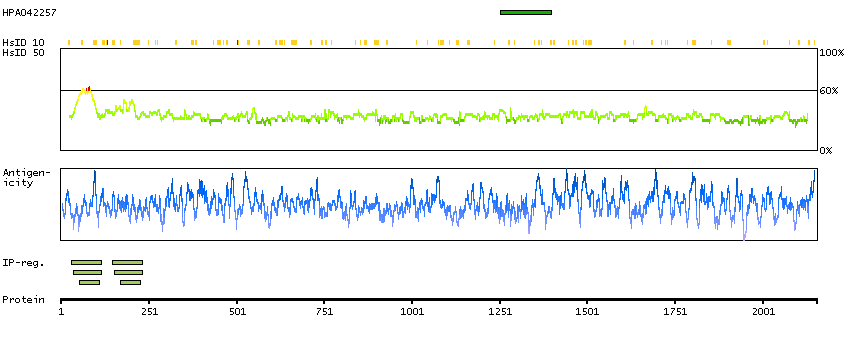
HPA042257
SHOW MORE

PROGNOSTIC SUMMARY

Gene product is not prognostic.
Show all

RNA EXPRESSION OVERVIEW

TCGA dataset
RNA cancer category: Not detected

PROTEIN EXPRESSION

Colorectal cancer
Breast cancer
Prostate cancer
Lung cancer
Liver cancer

STAINING SUMMARY

HPA042257

Cancer

Cancer staining

Protein
expression of
normal tissue

Breast cancer
 
Carcinoid
 
Cervical cancer
 
 
Colorectal cancer
 
 
Endometrial cancer
 
 
Glioma
 
Head and neck cancer
 
 
Liver cancer
 
 
Lung cancer
 
 
Lymphoma


Cancer

Cancer staining

Protein
expression of
normal tissue

Melanoma
 
Ovarian cancer
 
Pancreatic cancer
 
Prostate cancer
 
Renal cancer
 
Skin cancer
 
Stomach cancer
 
 
Testis cancer
 
Thyroid cancer
 
Urothelial cancer
 

Staining summary

Cancer tissues were negative.

GENE INFORMATION

Gene name

RP1 (HGNC Symbol)

Synonyms

DCDC4A

Description

Retinitis pigmentosa 1 (autosomal dominant) (HGNC Symbol)

Entrez gene summary

This gene encodes a member of the doublecortin family. The protein encoded by this gene contains two doublecortin domains, which bind microtubules and regulate microtubule polymerization. The encoded protein is a photoreceptor microtubule-associated protein and is required for correct stacking of outer segment disc. This protein and the RP1L1 protein, another retinal-specific protein, play essential and synergistic roles in affecting photosensitivity and outer segment morphogenesis of rod photoreceptors. Because of its response to in vivo retinal oxygen levels, this protein was initially named ORP1 (oxygen-regulated protein-1). This protein was subsequently designated RP1 (retinitis pigmentosa 1) when it was found that mutations in this gene cause autosomal dominant retinitis pigmentosa. Mutations in this gene also cause autosomal recessive retinitis pigmentosa. Transcript variants resulted from an alternative promoter and alternative splicings have been found, which overlap the current reference sequence and has several exons upstream and downstream of the current reference sequence. However, the biological validity and full-length nature of some variants cannot be determined at this time.[provided by RefSeq, Sep 2010]

Chromosome

8

Cytoband

q12.1

Chromosome location (bp)

54616067 - 54630834

Protein evidence

Evidence at protein level (all genes)

Ensembl

ENSG00000104237 (version 83.38)

Entrez gene

6101

UniProt

P56715 (UniProt - Evidence at protein level)

neXtProt

NX_P56715

Antibodypedia

RP1 antibodies

PROTEIN BROWSER

RP1-001

PROTEIN INFORMATION

Splice variant

UniProt

Protein class

Gene ontology

Length & mass

Signal peptide
(predicted)

Transmembrane regions
(predicted)

RP1-001
ENSP00000220676
ENST00000220676
P56715 [Direct mapping]
Oxygen-regulated protein 1
Show all
   THUMBUP predicted membrane proteins
Predicted intracellular proteins
Disease related genes
Protein evidence (Kim et al 2014)
Show all
GO:0001750 [photoreceptor outer segment]
GO:0001917 [photoreceptor inner segment]
GO:0005515 [protein binding]
GO:0005874 [microtubule]
GO:0005875 [microtubule associated complex]
GO:0005929 [cilium]
GO:0005930 [axoneme]
GO:0007601 [visual perception]
GO:0007603 [phototransduction, visible light]
GO:0008017 [microtubule binding]
GO:0032391 [photoreceptor connecting cilium]
GO:0035082 [axoneme assembly]
GO:0035556 [intracellular signal transduction]
GO:0035845 [photoreceptor cell outer segment organization]
GO:0042461 [photoreceptor cell development]
GO:0045494 [photoreceptor cell maintenance]
GO:0046548 [retinal rod cell development]
GO:0046549 [retinal cone cell development]
GO:0060041 [retina development in camera-type eye]
GO:0060042 [retina morphogenesis in camera-type eye]
GO:0071482 [cellular response to light stimulus]
Show all
2156 aa
240.7 kDa
No 0

Contact

  • BLOG
  • PRESS ROOM
  • contact@proteinatlas.org

The Project

  • INTRODUCTION
  • ORGANIZATION
  • PUBLICATIONS
  • DOWNLOADABLE DATA

The Human Protein Atlas

  • ANTIBODY AVAILABILITY
  • LICENCE & CITATION
  • HELP & FAQ
The Human Protein Atlas project is funded
by the Knut & Alice Wallenberg foundation.