We use cookies to enhance the usability of our website. If you continue, we'll assume that you are happy to receive all cookies. More information. Don't show this again.
Fields »
 

Field

Term
Gene name

Class

Subclass

Chromosome

External id

In atlas

Reliability

Reliability

Reliability

Validation

Method

Validation

Method

Validation

Method

Validation

Location

Searches

Tissue

Cell type

Expression

Tissue

Specificity

Cell line

Specificity

Cancer

Specificity

Tissue

Detectable

Cell line

Detectable

Cancer

Detectable

Cancer

Prognosis

Category

Score

Score

Score

Antibodies

Column


ABOUT
HELP
BLOG
  • THE HUMAN PROTEOME
  • THE HUMAN TISSUES
  • THE HUMAN CELL
  • HUMAN PATHOLOGY
  • PROTEIN CLASSES
  • PROTEIN EVIDENCE
    • NEWS
    • BLOG
    • EVENTS
    • PRESS ROOM
    • LEARN
    • DICTIONARY
    • METHODS
    • CELL LINES
  • THE PROJECT
  • INTRODUCTION
  • ORGANIZATION
  • PUBLICATIONS
  • PUBLICATION DATA
  • ANTIBODY SUBMISSION
  • ANTIBODY AVAILABILITY
  • LINKS
  • CONTACT
  • TECHNICAL DATA
  • ANTIBODY VALIDATION
  • ASSAYS & ANNOTATION
  • DISCLAIMER
  • DOWNLOADABLE DATA
  • HELP & FAQ
  • LICENCE & CITATION
  • PRIVACY STATEMENT
  • RELEASE HISTORY
PRB4
  • TISSUE

  • CELL

  • PATHOLOGY

TISSUE ATLAS

GENE/PROTEIN

Dictionary


Tissue proteome

GENERAL INFORMATION

Gene name

PRB4

Gene description

Proline-rich protein BstNI subfamily 4

Protein class

Predicted secreted proteins

Predicted localization

Secreted

Number of transcripts

4
SHOW MORE

HUMAN PROTEIN ATLAS INFORMATION

RNA tissue category

HPA:Tissue enriched (salivary gland)
GTEx:Tissue enhanced (testis)
FANTOM5:Group enriched (lung, salivary gland)

Protein evidence

Evidence at transcript level

DATA RELIABILITY

Reliability score

Pending normal tissue annotation.

RNA AND PROTEIN EXPRESSION SUMMARY

RNA expression (TPM) Protein expression (score)
Brain
N/A
Cerebral cortex
N/A
Hippocampus
N/A
N/A
Caudate
N/A
N/A
Cerebellum
N/A
N/A
Endocrine tissues
N/A
Thyroid gland
N/A
Parathyroid gland
N/A
Adrenal gland
N/A
Bone marrow & immune system
N/A
Appendix
N/A
Bone marrow
N/A
Lymph node
N/A
Tonsil
N/A
Spleen
N/A
Muscle tissues
N/A
Heart muscle
N/A
Skeletal muscle
N/A
Smooth muscle
N/A
Lung
N/A
Nasopharynx
N/A
N/A
Bronchus
N/A
N/A
Lung
N/A
Liver & gallbladder
N/A
Liver
N/A
Gallbladder
N/A
Pancreas
N/A
Pancreas
N/A
Gastrointestinal tract
N/A
Oral mucosa
N/A
N/A
Salivary gland
N/A
Esophagus
N/A
Stomach
N/A
Duodenum
N/A
Small intestine
N/A
Colon
N/A
Rectum
N/A
Kidney & urinary bladder
N/A
Kidney
N/A
Urinary bladder
N/A
Male tissues
N/A
Testis
N/A
Epididymis
N/A
Prostate
N/A
Seminal vesicle
N/A
Female tissues
N/A
Breast
N/A
Vagina
N/A
N/A
Cervix, uterine
N/A
Endometrium
N/A
Fallopian tube
N/A
Ovary
N/A
Placenta
N/A
Adipose & soft tissue
N/A
Adipose tissue
N/A
Soft tissue
N/A
N/A
Skin
N/A
Skin
N/A

PROTEIN EXPRESSION OVERVIEW

Pending normal tissue annotation.

RNA EXPRESSION OVERVIEW

HPA dataset
Organ
Expression
Alphabetical
RNA tissue category: Tissue enriched (salivary gland)
GTEx dataset
Organ
Expression
Alphabetical
RNA tissue category: Tissue enhanced (testis)
FANTOM5 dataset
Organ
Expression
Alphabetical
RNA tissue category: Group enriched (lung, salivary gland)

GENE INFORMATION

Gene name

PRB4

Synonyms

Description

Proline-rich protein BstNI subfamily 4 (HGNC Symbol)

Entrez gene summary

This gene encodes a member of the heterogeneous family of basic, proline-rich, human salivary glycoproteins. The encoded preproprotein undergoes proteolytic processing to generate one or more mature peptides before secretion from the parotid glands. Multiple alleles of this gene exhibiting variations in the length of the tandem repeats have been identified. The reference genome encodes the ""Small"" allele. This gene is located in a cluster of closely related salivary proline-rich proteins on chromosome 12. Alternative splicing results in multiple transcript variants encoding different isoforms that may undergo similar proteolytic processing. [provided by RefSeq, Nov 2015]

Chromosome

12

Cytoband

p13.2

Chromosome location (bp)

11307083 - 11310435

Protein evidence

Evidence at transcript level (all genes)

Ensembl

ENSG00000230657 (version 83.38)

Entrez gene

5545

UniProt

neXtProt

Antibodypedia

PRB4 antibodies

PROTEIN BROWSER

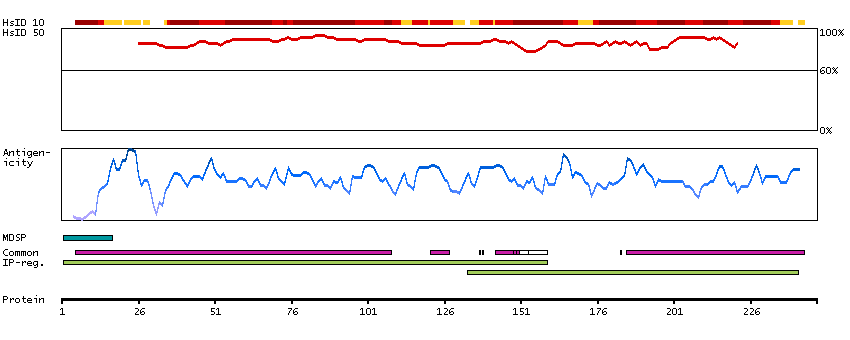
PRB4-001
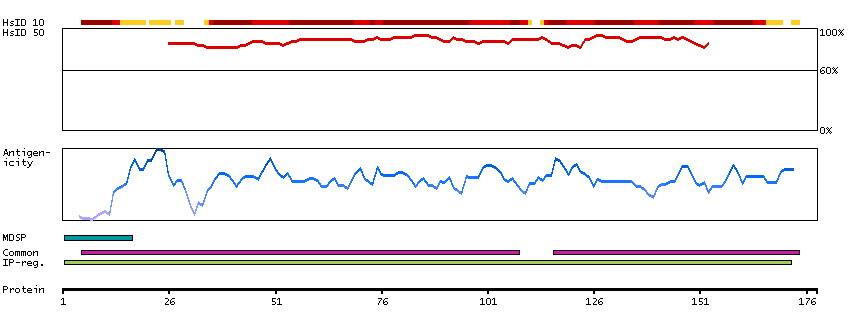
PRB4-002
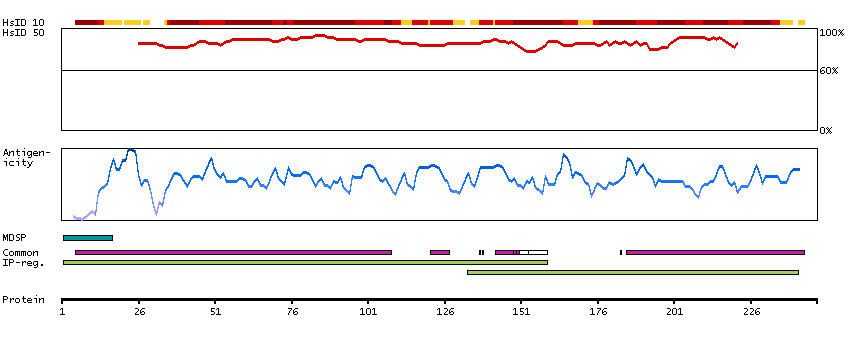
PRB4-201
PRB4-202

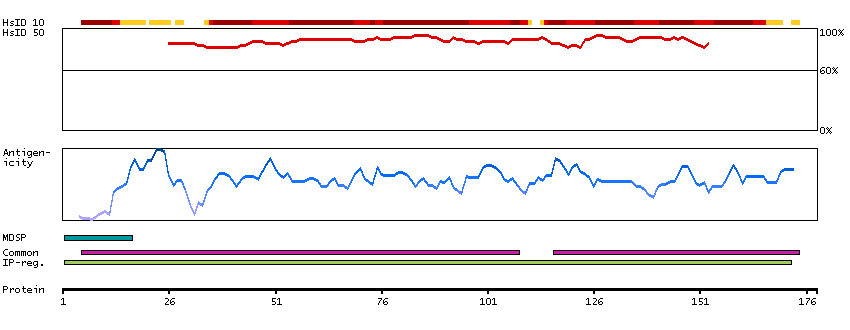
PROTEIN INFORMATION

Splice variant

UniProt

Protein class

Gene ontology

Length & mass

Signal peptide
(predicted)

Transmembrane regions
(predicted)

PRB4-001
ENSP00000442834
ENST00000535904
E9PAL0 [Direct mapping]
Basic salivary proline-rich protein 1; Basic salivary proline-rich protein 4
Show all
Predicted secreted proteins
   Secreted proteins predicted by MDSEC
   SignalP predicted secreted proteins
   Phobius predicted secreted proteins
   SPOCTOPUS predicted secreted proteins
Show all
247 aa
25.1 kDa
Yes 0
PRB4-002
ENSP00000412740
ENST00000445719
E7EXA8 [Direct mapping]
Basic salivary proline-rich protein 4
Show all
Predicted secreted proteins
   Secreted proteins predicted by MDSEC
   SignalP predicted secreted proteins
   Phobius predicted secreted proteins
   SPOCTOPUS predicted secreted proteins
Show all
178 aa
18 kDa
Yes 0
PRB4-201
ENSP00000279575
ENST00000279575
E9PAL0 [Direct mapping]
Basic salivary proline-rich protein 1; Basic salivary proline-rich protein 4
Show all
Predicted secreted proteins
   Secreted proteins predicted by MDSEC
   SignalP predicted secreted proteins
   Phobius predicted secreted proteins
   SPOCTOPUS predicted secreted proteins
Show all
247 aa
25.1 kDa
Yes 0
PRB4-202
ENSP00000481695
ENST00000621732
E7EXA8 [Direct mapping]
Basic salivary proline-rich protein 4
Show all
Predicted secreted proteins
   Secreted proteins predicted by MDSEC
   SignalP predicted secreted proteins
   Phobius predicted secreted proteins
   SPOCTOPUS predicted secreted proteins
Show all
178 aa
18 kDa
Yes 0

Contact

  • BLOG
  • PRESS ROOM
  • contact@proteinatlas.org

The Project

  • INTRODUCTION
  • ORGANIZATION
  • PUBLICATIONS
  • DOWNLOADABLE DATA

The Human Protein Atlas

  • ANTIBODY AVAILABILITY
  • LICENCE & CITATION
  • HELP & FAQ
The Human Protein Atlas project is funded
by the Knut & Alice Wallenberg foundation.