We use cookies to enhance the usability of our website. If you continue, we'll assume that you are happy to receive all cookies. More information. Don't show this again.
Fields »
 

Field

Term
Gene name

Class

Subclass

Chromosome

External id

In atlas

Reliability

Reliability

Reliability

Validation

Method

Validation

Method

Validation

Method

Validation

Location

Searches

Tissue

Cell type

Expression

Tissue

Specificity

Cell line

Specificity

Cancer

Specificity

Tissue

Detectable

Cell line

Detectable

Cancer

Detectable

Cancer

Prognosis

Category

Score

Score

Score

Antibodies

Column


ABOUT
HELP
BLOG
  • THE HUMAN PROTEOME
  • THE HUMAN TISSUES
  • THE HUMAN CELL
  • HUMAN PATHOLOGY
  • PROTEIN CLASSES
  • PROTEIN EVIDENCE
    • NEWS
    • BLOG
    • EVENTS
    • PRESS ROOM
    • LEARN
    • DICTIONARY
    • METHODS
    • CELL LINES
  • THE PROJECT
  • INTRODUCTION
  • ORGANIZATION
  • PUBLICATIONS
  • PUBLICATION DATA
  • ANTIBODY SUBMISSION
  • ANTIBODY AVAILABILITY
  • LINKS
  • CONTACT
  • TECHNICAL DATA
  • ANTIBODY VALIDATION
  • ASSAYS & ANNOTATION
  • DISCLAIMER
  • DOWNLOADABLE DATA
  • HELP & FAQ
  • LICENCE & CITATION
  • PRIVACY STATEMENT
  • RELEASE HISTORY
STARD7
  • premium

    TISSUE

  • CELL

  • PATHOLOGY

PATHOLOGY ATLAS

GENE/PROTEIN

Antibody validation

Dictionary

Level of antibody staining/expression


High
Medium
Low
Not detected

GENERAL INFORMATION

Gene name

STARD7

Gene description

StAR-related lipid transfer (START) domain containing 7

Protein class

Predicted intracellular proteins
Predicted secreted proteins

Predicted localization

Intracellular,Secreted

Number of transcripts

2
SHOW MORE

HUMAN PROTEIN ATLAS INFORMATION

RNA category

TCGA (cancer tissue):Expressed in all
HPA (cell line):Expressed in all
HPA (normal tissue):Expressed in all

Protein evidence

Evidence at protein level

Protein expression
normal tissue

Cytoplasmic expression with a granular pattern in most tissues.

ANTIBODY IHC RELIABILITY

Data reliability
description

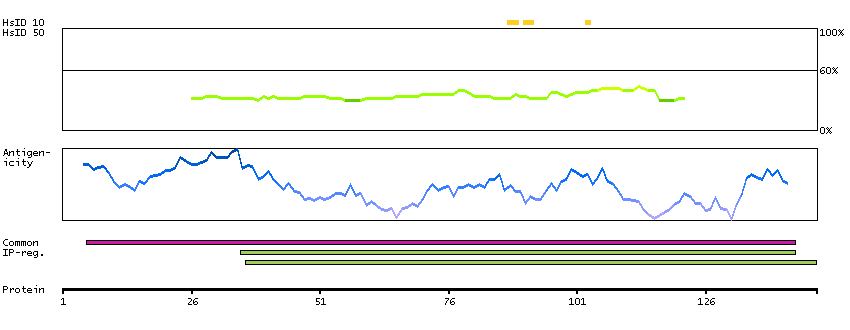
Antibody staining mainly consistent with RNA expression data.

Reliability score

Supported based on 2 antibodies.
HPA064978 , CAB033965
SHOW MORE

PROGNOSTIC SUMMARY

Prognostic marker in renal cancer (favourable), glioma (favourable), endometrial cancer (unfavourable) and liver cancer (unfavourable).
Renal cancer p<0.001
Glioma p<0.001
Endometrial cancer p<0.001
Liver cancer p<0.001
Show all

RNA EXPRESSION OVERVIEW

TCGA dataset
RNA cancer category: Expressed in all

PROTEIN EXPRESSION

Colorectal cancer
Breast cancer
Prostate cancer
Lung cancer
Liver cancer

STAINING SUMMARY

HPA064978
CAB033965

Cancer

Cancer staining

Protein
expression of
normal tissue

Breast cancer
 
Carcinoid
 
Cervical cancer
 
 
Colorectal cancer
 
 
Endometrial cancer
 
 
Glioma
 
Head and neck cancer
 
 
Liver cancer
 
 
Lung cancer
 
 
Lymphoma


Cancer

Cancer staining

Protein
expression of
normal tissue

Melanoma
 
Ovarian cancer
 
Pancreatic cancer
 
Prostate cancer
 
Renal cancer
 
Skin cancer
 
Stomach cancer
 
 
Testis cancer
 
Thyroid cancer
 
Urothelial cancer
 

Staining summary

Most cancer tissues showed weak to moderate cytoplasmic positivity with additional membranous staining in colorectal and pancreatic cancers.

Cancer

Cancer staining

Protein
expression of
normal tissue

Breast cancer
 
Carcinoid
 
Cervical cancer
 
 
Colorectal cancer
 
 
Endometrial cancer
 
 
Glioma
 
Head and neck cancer
 
 
Liver cancer
 
 
Lung cancer
 
 
Lymphoma


Cancer

Cancer staining

Protein
expression of
normal tissue

Melanoma
 
Ovarian cancer
 
Pancreatic cancer
 
Prostate cancer
 
Renal cancer
 
Skin cancer
 
Stomach cancer
 
 
Testis cancer
 
Thyroid cancer
 
Urothelial cancer
 

Staining summary

Most cancer cells displayed moderate cytoplasmic immunoreactivity, often with a granular pattern. Several cases of renal cancers along with a few cases of prostate and endometrial cancers were strongly stained. Several cases of lymphomas, gliomas and ovarian cancers were weakly stained or negative.

GENE INFORMATION

Gene name

STARD7 (HGNC Symbol)

Synonyms

GTT1

Description

StAR-related lipid transfer (START) domain containing 7 (HGNC Symbol)

Entrez gene summary

Although the function of this gene is not known, its existence is supported by mRNA and EST data. The predicted gene product contains a region similar to the STAR-related lipid transfer (START) domain, which is often present in proteins involved in the cell signaling mediated by lipid binding. Alternatively spliced transcript variants have been described, although some transcripts occur only in cancer cell lines. [provided by RefSeq, Jul 2008]

Chromosome

2

Cytoband

q11.2

Chromosome location (bp)

96184859 - 96208825

Protein evidence

Evidence at protein level (all genes)

Ensembl

ENSG00000084090 (version 83.38)

Entrez gene

56910

UniProt

Q9NQZ5 (UniProt - Evidence at protein level)

neXtProt

NX_Q9NQZ5

Antibodypedia

STARD7 antibodies

PROTEIN BROWSER

STARD7-001
STARD7-006

PROTEIN INFORMATION

Splice variant

UniProt

Protein class

Gene ontology

Length & mass

Signal peptide
(predicted)

Transmembrane regions
(predicted)

STARD7-001
ENSP00000338030
ENST00000337288
Q9NQZ5 [Direct mapping]
StAR-related lipid transfer protein 7, mitochondrial
Show all
Predicted secreted proteins
   Secreted proteins predicted by MDSEC
   Phobius predicted secreted proteins
   SPOCTOPUS predicted secreted proteins
Protein evidence (Kim et al 2014)
Protein evidence (Ezkurdia et al 2014)
Show all
GO:0005739 [mitochondrion]
GO:0008289 [lipid binding]
GO:1903955 [positive regulation of protein targeting to mitochondrion]
Show all
370 aa
43.1 kDa
Yes 0
STARD7-006
ENSP00000409410
ENST00000443962
C9JTD3 [Direct mapping]
StAR-related lipid transfer protein 7, mitochondrial
Show all
Predicted intracellular proteins
Protein evidence (Ezkurdia et al 2014)
Show all
GO:0008289 [lipid binding]
Show all
147 aa
17.8 kDa
No 0

Contact

  • BLOG
  • PRESS ROOM
  • contact@proteinatlas.org

The Project

  • INTRODUCTION
  • ORGANIZATION
  • PUBLICATIONS
  • DOWNLOADABLE DATA

The Human Protein Atlas

  • ANTIBODY AVAILABILITY
  • LICENCE & CITATION
  • HELP & FAQ
The Human Protein Atlas project is funded
by the Knut & Alice Wallenberg foundation.