We use cookies to enhance the usability of our website. If you continue, we'll assume that you are happy to receive all cookies. More information. Don't show this again.
Fields »
 

Field

Term
Gene name

Class

Subclass

Chromosome

External id

In atlas

Reliability

Reliability

Reliability

Validation

Method

Validation

Method

Validation

Method

Validation

Location

Searches

Tissue

Cell type

Expression

Tissue

Specificity

Cell line

Specificity

Cancer

Specificity

Tissue

Detectable

Cell line

Detectable

Cancer

Detectable

Cancer

Prognosis

Category

Score

Score

Score

Antibodies

Column


ABOUT
HELP
BLOG
  • THE HUMAN PROTEOME
  • THE HUMAN TISSUES
  • THE HUMAN CELL
  • HUMAN PATHOLOGY
  • PROTEIN CLASSES
  • PROTEIN EVIDENCE
    • NEWS
    • BLOG
    • EVENTS
    • PRESS ROOM
    • LEARN
    • DICTIONARY
    • METHODS
    • CELL LINES
  • THE PROJECT
  • INTRODUCTION
  • ORGANIZATION
  • PUBLICATIONS
  • PUBLICATION DATA
  • ANTIBODY SUBMISSION
  • ANTIBODY AVAILABILITY
  • LINKS
  • CONTACT
  • TECHNICAL DATA
  • ANTIBODY VALIDATION
  • ASSAYS & ANNOTATION
  • DISCLAIMER
  • DOWNLOADABLE DATA
  • HELP & FAQ
  • LICENCE & CITATION
  • PRIVACY STATEMENT
  • RELEASE HISTORY
GTPBP4
  • TISSUE

  • premium

    CELL

  • PATHOLOGY

TISSUE ATLAS PRIMARY DATA

GENE/PROTEIN

Antibody validation


Dictionary


Tissue proteome

GENERAL INFORMATION

Gene name

GTPBP4

Gene description

GTP binding protein 4

Protein class

Predicted intracellular proteins

Predicted localization

Intracellular

Number of transcripts

2
SHOW MORE

HUMAN PROTEIN ATLAS INFORMATION

RNA tissue category

HPA:Expressed in all
GTEx:Expressed in all
FANTOM5:Expressed in all

Protein evidence

Evidence at protein level

Protein expression

Cytoplasmic and nucleolar expression in several different tissue types.

DATA RELIABILITY

Data reliability
description

Antibody staining mainly not consistent with RNA expression data. Presumed off target binding observed and disregarded.

Reliability score

Uncertain based on 1 antibody.
HPA039618
SHOW MORE

RNA AND PROTEIN EXPRESSION SUMMARY

RNA expression (TPM) Protein expression (score)
Brain
Cerebral cortex
Hippocampus
N/A
Caudate
N/A
Cerebellum
N/A
Endocrine tissues
Thyroid gland
Parathyroid gland
Adrenal gland
Bone marrow & immune system
Appendix
Bone marrow
Lymph node
Tonsil
Spleen
Muscle tissues
Heart muscle
Skeletal muscle
Smooth muscle
Lung
Nasopharynx
N/A
Bronchus
N/A
Lung
Liver & gallbladder
Liver
Gallbladder
Pancreas
Pancreas
Gastrointestinal tract
Oral mucosa
N/A
Salivary gland
Esophagus
Stomach
Duodenum
Small intestine
Colon
Rectum
Kidney & urinary bladder
Kidney
Urinary bladder
Male tissues
Testis
Epididymis
Prostate
Seminal vesicle
Female tissues
Breast
Vagina
N/A
Cervix, uterine
Endometrium
Fallopian tube
Ovary
Placenta
Adipose & soft tissue
Adipose tissue
Soft tissue
N/A
Skin
Skin
Cerebral cortex

Lymph node

Liver

Colon

Kidney

Testis

PROTEIN EXPRESSION OVERVIEW

Organ
Expression
Alphabetical

RNA EXPRESSION OVERVIEW

HPA dataset
Organ
Expression
Alphabetical
RNA tissue category: Expressed in all
GTEx dataset
Organ
Expression
Alphabetical
RNA tissue category: Expressed in all
FANTOM5 dataset
Organ
Expression
Alphabetical
RNA tissue category: Expressed in all

GENE INFORMATION

Gene name

GTPBP4 (HGNC Symbol)

Synonyms

CRFG, FLJ10686, FLJ10690, NGB, NOG1

Description

GTP binding protein 4 (HGNC Symbol)

Entrez gene summary

GTP-binding proteins are GTPases and function as molecular switches that can flip between two states: active, when GTP is bound, and inactive, when GDP is bound. 'Active' in this context usually means that the molecule acts as a signal to trigger other events in the cell. When an extracellular ligand binds to a G-protein-linked receptor, the receptor changes its conformation and switches on the trimeric G proteins that associate with it by causing them to eject their GDP and replace it with GTP. The switch is turned off when the G protein hydrolyzes its own bound GTP, converting it back to GDP. But before that occurs, the active protein has an opportunity to diffuse away from the receptor and deliver its message for a prolonged period to its downstream target. [provided by RefSeq, Jul 2008]

Chromosome

10

Cytoband

p15.3

Chromosome location (bp)

988019 - 1019936

Protein evidence

Evidence at protein level (all genes)

Ensembl

ENSG00000107937 (version 83.38)

Entrez gene

23560

UniProt

Q9BZE4 (UniProt - Evidence at protein level)

neXtProt

NX_Q9BZE4

Antibodypedia

GTPBP4 antibodies

PROTEIN BROWSER

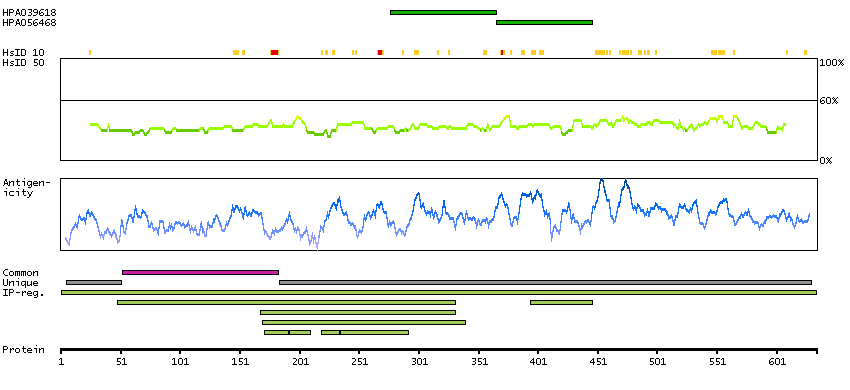
GTPBP4-001
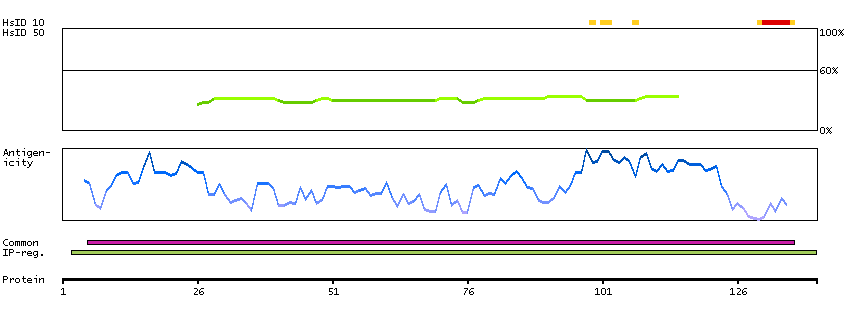
GTPBP4-006

PROTEIN INFORMATION

Splice variant

UniProt

Protein class

Gene ontology

Length & mass

Signal peptide
(predicted)

Transmembrane regions
(predicted)

GTPBP4-001
ENSP00000354040
ENST00000360803
Q9BZE4 [Direct mapping]
Nucleolar GTP-binding protein 1
D2CFK9 [Target identity:100%; Query identity:100%]
Nucleolar GTP-binding protein 1
Show all
Predicted intracellular proteins
Protein evidence (Kim et al 2014)
Protein evidence (Ezkurdia et al 2014)
Show all
GO:0000079 [regulation of cyclin-dependent protein serine/threonine kinase activity]
GO:0001649 [osteoblast differentiation]
GO:0003924 [GTPase activity]
GO:0005515 [protein binding]
GO:0005525 [GTP binding]
GO:0005634 [nucleus]
GO:0005730 [nucleolus]
GO:0005737 [cytoplasm]
GO:0005794 [Golgi apparatus]
GO:0008156 [negative regulation of DNA replication]
GO:0008285 [negative regulation of cell proliferation]
GO:0016020 [membrane]
GO:0022408 [negative regulation of cell-cell adhesion]
GO:0030336 [negative regulation of cell migration]
GO:0031397 [negative regulation of protein ubiquitination]
GO:0031965 [nuclear membrane]
GO:0033342 [negative regulation of collagen binding]
GO:0042254 [ribosome biogenesis]
GO:0044822 [poly(A) RNA binding]
GO:0048471 [perinuclear region of cytoplasm]
GO:0050821 [protein stabilization]
Show all
634 aa
74 kDa
No 0
GTPBP4-006
ENSP00000353168
ENST00000360059
Q5T3R7 [Direct mapping]
Nucleolar GTP-binding protein 1
Show all
Predicted intracellular proteins
Protein evidence (Ezkurdia et al 2014)
Show all
140 aa
16.5 kDa
No 0

Contact

  • BLOG
  • PRESS ROOM
  • contact@proteinatlas.org

The Project

  • INTRODUCTION
  • ORGANIZATION
  • PUBLICATIONS
  • DOWNLOADABLE DATA

The Human Protein Atlas

  • ANTIBODY AVAILABILITY
  • LICENCE & CITATION
  • HELP & FAQ
The Human Protein Atlas project is funded
by the Knut & Alice Wallenberg foundation.