We use cookies to enhance the usability of our website. If you continue, we'll assume that you are happy to receive all cookies. More information. Don't show this again.
Fields »
 

Field

Term
Gene name

Class

Subclass

Chromosome

External id

In atlas

Reliability

Reliability

Reliability

Validation

Method

Validation

Method

Validation

Method

Validation

Location

Searches

Tissue

Cell type

Expression

Tissue

Specificity

Cell line

Specificity

Cancer

Specificity

Tissue

Detectable

Cell line

Detectable

Cancer

Detectable

Cancer

Prognosis

Category

Score

Score

Score

Antibodies

Column


ABOUT
HELP
BLOG
  • THE HUMAN PROTEOME
  • THE HUMAN TISSUES
  • THE HUMAN CELL
  • HUMAN PATHOLOGY
  • PROTEIN CLASSES
  • PROTEIN EVIDENCE
    • NEWS
    • BLOG
    • EVENTS
    • PRESS ROOM
    • LEARN
    • DICTIONARY
    • METHODS
    • CELL LINES
  • THE PROJECT
  • INTRODUCTION
  • ORGANIZATION
  • PUBLICATIONS
  • PUBLICATION DATA
  • ANTIBODY SUBMISSION
  • ANTIBODY AVAILABILITY
  • LINKS
  • CONTACT
  • TECHNICAL DATA
  • ANTIBODY VALIDATION
  • ASSAYS & ANNOTATION
  • DISCLAIMER
  • DOWNLOADABLE DATA
  • HELP & FAQ
  • LICENCE & CITATION
  • PRIVACY STATEMENT
  • RELEASE HISTORY
CD274
  • TISSUE

  • CELL

  • PATHOLOGY

TISSUE ATLAS

GENE/PROTEIN

Dictionary


Tissue proteome

GENERAL INFORMATION

Gene name

CD274

Gene description

CD274 molecule

Protein class

Cancer-related genes
CD markers
Predicted membrane proteins

Predicted localization

Membrane

Number of transcripts

2
SHOW MORE

HUMAN PROTEIN ATLAS INFORMATION

RNA tissue category

HPA:Mixed
GTEx:Tissue enhanced (lung)
FANTOM5:Tissue enhanced (placenta)

Protein evidence

Evidence at protein level

DATA RELIABILITY

Reliability score

Pending normal tissue annotation.

RNA AND PROTEIN EXPRESSION SUMMARY

RNA expression (TPM) Protein expression (score)
Brain
N/A
Cerebral cortex
N/A
Hippocampus
N/A
N/A
Caudate
N/A
N/A
Cerebellum
N/A
N/A
Endocrine tissues
N/A
Thyroid gland
N/A
Parathyroid gland
N/A
Adrenal gland
N/A
Bone marrow & immune system
N/A
Appendix
N/A
Bone marrow
N/A
Lymph node
N/A
Tonsil
N/A
Spleen
N/A
Muscle tissues
N/A
Heart muscle
N/A
Skeletal muscle
N/A
Smooth muscle
N/A
Lung
N/A
Nasopharynx
N/A
N/A
Bronchus
N/A
N/A
Lung
N/A
Liver & gallbladder
N/A
Liver
N/A
Gallbladder
N/A
Pancreas
N/A
Pancreas
N/A
Gastrointestinal tract
N/A
Oral mucosa
N/A
N/A
Salivary gland
N/A
Esophagus
N/A
Stomach
N/A
Duodenum
N/A
Small intestine
N/A
Colon
N/A
Rectum
N/A
Kidney & urinary bladder
N/A
Kidney
N/A
Urinary bladder
N/A
Male tissues
N/A
Testis
N/A
Epididymis
N/A
Prostate
N/A
Seminal vesicle
N/A
Female tissues
N/A
Breast
N/A
Vagina
N/A
N/A
Cervix, uterine
N/A
Endometrium
N/A
Fallopian tube
N/A
Ovary
N/A
Placenta
N/A
Adipose & soft tissue
N/A
Adipose tissue
N/A
Soft tissue
N/A
N/A
Skin
N/A
Skin
N/A

PROTEIN EXPRESSION OVERVIEW

Pending normal tissue annotation.

RNA EXPRESSION OVERVIEW

HPA dataset
Organ
Expression
Alphabetical
RNA tissue category: Mixed
GTEx dataset
Organ
Expression
Alphabetical
RNA tissue category: Tissue enhanced (lung)
FANTOM5 dataset
Organ
Expression
Alphabetical
RNA tissue category: Tissue enhanced (placenta)

GENE INFORMATION

Gene name

CD274 (HGNC Symbol)

Synonyms

B7-H, B7-H1, B7H1, PD-L1, PDCD1LG1, PDL1

Description

CD274 molecule (HGNC Symbol)

Entrez gene summary

This gene encodes an immune inhibitory receptor ligand that is expressed by hematopoietic and non-hematopoietic cells, such as T cells and B cells and various types of tumor cells. The encoded protein is a type I transmembrane protein that has immunoglobulin V-like and C-like domains. Interaction of this ligand with its receptor inhibits T-cell activation and cytokine production. During infection or inflammation of normal tissue, this interaction is important for preventing autoimmunity by maintaining homeostasis of the immune response. In tumor microenvironments, this interaction provides an immune escape for tumor cells through cytotoxic T-cell inactivation. Expression of this gene in tumor cells is considered to be prognostic in many types of human malignancies, including colon cancer and renal cell carcinoma. Alternative splicing results in multiple transcript variants. [provided by RefSeq, Sep 2015]

Chromosome

9

Cytoband

p24.1

Chromosome location (bp)

5450503 - 5470566

Protein evidence

Evidence at protein level (all genes)

Ensembl

ENSG00000120217 (version 83.38)

Entrez gene

29126

UniProt

Q9NZQ7 (UniProt - Evidence at protein level)

neXtProt

NX_Q9NZQ7

Antibodypedia

CD274 antibodies

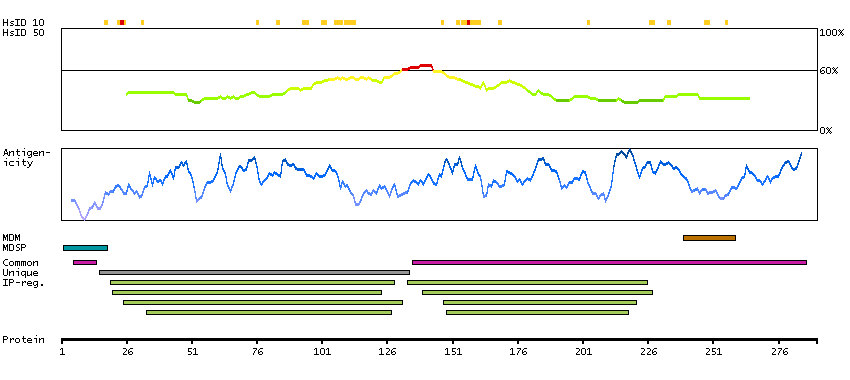
PROTEIN BROWSER

CD274-001
CD274-201

PROTEIN INFORMATION

Splice variant

UniProt

Protein class

Gene ontology

Length & mass

Signal peptide
(predicted)

Transmembrane regions
(predicted)

CD274-001
ENSP00000370989
ENST00000381577
Q9NZQ7 [Direct mapping]
Programmed cell death 1 ligand 1
Show all
CD markers
Predicted membrane proteins
   Prediction method-based
   Membrane proteins predicted by MDM
   MEMSAT3 predicted membrane proteins
   MEMSAT-SVM predicted membrane proteins
   Phobius predicted membrane proteins
   SCAMPI predicted membrane proteins
   SPOCTOPUS predicted membrane proteins
   THUMBUP predicted membrane proteins
   TMHMM predicted membrane proteins
   # TM segments-based
   1TM proteins predicted by MDM
Cancer-related genes
   COSMIC somatic mutations in cancer genes
   COSMIC Somatic Mutations
   COSMIC Translocations
Protein evidence (Kim et al 2014)
Protein evidence (Ezkurdia et al 2014)
Show all
GO:0005515 [protein binding]
GO:0005886 [plasma membrane]
GO:0006955 [immune response]
GO:0007165 [signal transduction]
GO:0007166 [cell surface receptor signaling pathway]
GO:0009897 [external side of plasma membrane]
GO:0009986 [cell surface]
GO:0012505 [endomembrane system]
GO:0016021 [integral component of membrane]
GO:0030335 [positive regulation of cell migration]
GO:0031295 [T cell costimulation]
GO:0032689 [negative regulation of interferon-gamma production]
GO:0032693 [negative regulation of interleukin-10 production]
GO:0034097 [response to cytokine]
GO:0042102 [positive regulation of T cell proliferation]
GO:0042130 [negative regulation of T cell proliferation]
GO:0046007 [negative regulation of activated T cell proliferation]
GO:0070062 [extracellular exosome]
GO:1901998 [toxin transport]
GO:1903556 [negative regulation of tumor necrosis factor superfamily cytokine production]
GO:2001181 [positive regulation of interleukin-10 secretion]
Show all
290 aa
33.3 kDa
Yes 1
CD274-201
ENSP00000370985
ENST00000381573
Q9NZQ7 [Direct mapping]
Programmed cell death 1 ligand 1
Show all
CD markers
Predicted membrane proteins
   Prediction method-based
   Membrane proteins predicted by MDM
   MEMSAT3 predicted membrane proteins
   MEMSAT-SVM predicted membrane proteins
   Phobius predicted membrane proteins
   SCAMPI predicted membrane proteins
   SPOCTOPUS predicted membrane proteins
   THUMBUP predicted membrane proteins
   TMHMM predicted membrane proteins
   # TM segments-based
   1TM proteins predicted by MDM
Cancer-related genes
   COSMIC somatic mutations in cancer genes
   COSMIC Somatic Mutations
   COSMIC Translocations
Protein evidence (Ezkurdia et al 2014)
Show all
GO:0005515 [protein binding]
GO:0005886 [plasma membrane]
GO:0006955 [immune response]
GO:0007165 [signal transduction]
GO:0007166 [cell surface receptor signaling pathway]
GO:0012505 [endomembrane system]
GO:0016021 [integral component of membrane]
GO:0031295 [T cell costimulation]
GO:0032689 [negative regulation of interferon-gamma production]
GO:0032693 [negative regulation of interleukin-10 production]
GO:0034097 [response to cytokine]
GO:0042102 [positive regulation of T cell proliferation]
GO:0046007 [negative regulation of activated T cell proliferation]
GO:0070062 [extracellular exosome]
GO:1903556 [negative regulation of tumor necrosis factor superfamily cytokine production]
GO:2001181 [positive regulation of interleukin-10 secretion]
Show all
176 aa
20.2 kDa
No 1

Contact

  • BLOG
  • PRESS ROOM
  • contact@proteinatlas.org

The Project

  • INTRODUCTION
  • ORGANIZATION
  • PUBLICATIONS
  • DOWNLOADABLE DATA

The Human Protein Atlas

  • ANTIBODY AVAILABILITY
  • LICENCE & CITATION
  • HELP & FAQ
The Human Protein Atlas project is funded
by the Knut & Alice Wallenberg foundation.