We use cookies to enhance the usability of our website. If you continue, we'll assume that you are happy to receive all cookies. More information. Don't show this again.
Fields »
 

Field

Term
Gene name

Class

Subclass

Chromosome

External id

In atlas

Reliability

Reliability

Reliability

Validation

Method

Validation

Method

Validation

Method

Validation

Location

Searches

Tissue

Cell type

Expression

Tissue

Specificity

Cell line

Specificity

Cancer

Specificity

Tissue

Detectable

Cell line

Detectable

Cancer

Detectable

Cancer

Prognosis

Category

Score

Score

Score

Antibodies

Column


ABOUT
HELP
BLOG
  • THE HUMAN PROTEOME
  • THE HUMAN TISSUES
  • THE HUMAN CELL
  • HUMAN PATHOLOGY
  • PROTEIN CLASSES
  • PROTEIN EVIDENCE
    • NEWS
    • BLOG
    • EVENTS
    • PRESS ROOM
    • LEARN
    • DICTIONARY
    • METHODS
    • CELL LINES
  • THE PROJECT
  • INTRODUCTION
  • ORGANIZATION
  • PUBLICATIONS
  • PUBLICATION DATA
  • ANTIBODY SUBMISSION
  • ANTIBODY AVAILABILITY
  • LINKS
  • CONTACT
  • TECHNICAL DATA
  • ANTIBODY VALIDATION
  • ASSAYS & ANNOTATION
  • DISCLAIMER
  • DOWNLOADABLE DATA
  • HELP & FAQ
  • LICENCE & CITATION
  • PRIVACY STATEMENT
  • RELEASE HISTORY
HIST1H3D
  • premium

    TISSUE

  • CELL

  • PATHOLOGY

TISSUE ATLAS PRIMARY DATA

GENE/PROTEIN

Antibody validation


Dictionary


Tissue proteome

GENERAL INFORMATION

Gene name

HIST1H3D

Gene description

Histone cluster 1, H3d

Protein class

Predicted intracellular proteins

Predicted localization

Intracellular

Number of transcripts

1
SHOW MORE

HUMAN PROTEIN ATLAS INFORMATION

RNA tissue category

HPA:Tissue enriched (bone marrow)
GTEx:Mixed
FANTOM5:Expressed in all

Protein evidence

Evidence at protein level

Protein expression

Ubiquitous nuclear expression.

DATA RELIABILITY

Data reliability
description

Caution, targets protein from more than one gene. Correlation with RNA expression data cannot be evaluated due to technical limitations (poly-A tail missing).

Reliability score

Supported based on 1 antibody.
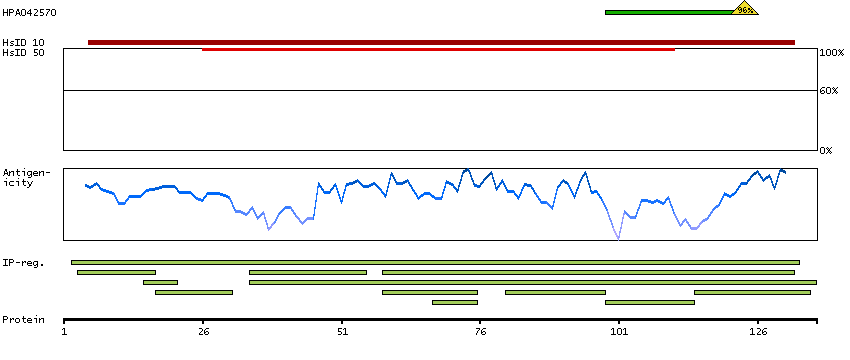
HPA042570
SHOW MORE

RNA AND PROTEIN EXPRESSION SUMMARY

RNA expression (TPM) Protein expression (score)
Brain
Cerebral cortex
Hippocampus
N/A
Caudate
N/A
Cerebellum
N/A
Endocrine tissues
Thyroid gland
Parathyroid gland
Adrenal gland
Bone marrow & immune system
Appendix
Bone marrow
Lymph node
Tonsil
Spleen
Muscle tissues
Heart muscle
Skeletal muscle
Smooth muscle
Lung
Nasopharynx
N/A
Bronchus
N/A
Lung
Liver & gallbladder
Liver
Gallbladder
Pancreas
Pancreas
Gastrointestinal tract
Oral mucosa
N/A
Salivary gland
Esophagus
Stomach
Duodenum
Small intestine
Colon
Rectum
Kidney & urinary bladder
Kidney
Urinary bladder
Male tissues
Testis
Epididymis
Prostate
Seminal vesicle
Female tissues
Breast
Vagina
N/A
Cervix, uterine
Endometrium
Fallopian tube
Ovary
Placenta
Adipose & soft tissue
Adipose tissue
Soft tissue
N/A
Skin
Skin
Cerebral cortex

Lymph node

Liver

Colon

Kidney

Testis

Skin

PROTEIN EXPRESSION OVERVIEW

Organ
Expression
Alphabetical

RNA EXPRESSION OVERVIEW

HPA dataset
Organ
Expression
Alphabetical
RNA tissue category: Tissue enriched (bone marrow)
GTEx dataset
Organ
Expression
Alphabetical
RNA tissue category: Mixed
FANTOM5 dataset
Organ
Expression
Alphabetical
RNA tissue category: Expressed in all

GENE INFORMATION

Gene name

HIST1H3D (HGNC Symbol)

Synonyms

H3/b, H3FB

Description

Histone cluster 1, H3d (HGNC Symbol)

Entrez gene summary

Histones are basic nuclear proteins that are responsible for the nucleosome structure of the chromosomal fiber in eukaryotes. Two molecules of each of the four core histones (H2A, H2B, H3, and H4) form an octamer, around which approximately 146 bp of DNA is wrapped in repeating units, called nucleosomes. The linker histone, H1, interacts with linker DNA between nucleosomes and functions in the compaction of chromatin into higher order structures. This gene is intronless and encodes a replication-dependent histone that is a member of the histone H3 family. Transcripts from this gene lack polyA tails but instead contain a palindromic termination element. This gene is found in the large histone gene cluster on chromosome 6. [provided by RefSeq, Aug 2015]

Chromosome

6

Cytoband

p22.2

Chromosome location (bp)

26196840 - 26197250

Protein evidence

Evidence at protein level (all genes)

Ensembl

ENSG00000197409 (version 83.38)

Entrez gene

8351

UniProt

P68431 (UniProt - Evidence at protein level)

neXtProt

NX_P68431

Antibodypedia

HIST1H3D antibodies

PROTEIN BROWSER

HIST1H3D-001

PROTEIN INFORMATION

Splice variant

UniProt

Protein class

Gene ontology

Length & mass

Signal peptide
(predicted)

Transmembrane regions
(predicted)

HIST1H3D-001
ENSP00000366999
ENST00000356476
P68431 [Direct mapping]
Histone H3.1
Show all
Predicted intracellular proteins
Show all
GO:0000183 [chromatin silencing at rDNA]
GO:0000228 [nuclear chromosome]
GO:0000786 [nucleosome]
GO:0000788 [nuclear nucleosome]
GO:0002230 [positive regulation of defense response to virus by host]
GO:0003677 [DNA binding]
GO:0005515 [protein binding]
GO:0005576 [extracellular region]
GO:0005634 [nucleus]
GO:0005654 [nucleoplasm]
GO:0006325 [chromatin organization]
GO:0006334 [nucleosome assembly]
GO:0006335 [DNA replication-dependent nucleosome assembly]
GO:0007264 [small GTPase mediated signal transduction]
GO:0007596 [blood coagulation]
GO:0010467 [gene expression]
GO:0016020 [membrane]
GO:0031047 [gene silencing by RNA]
GO:0032776 [DNA methylation on cytosine]
GO:0040029 [regulation of gene expression, epigenetic]
GO:0042393 [histone binding]
GO:0043234 [protein complex]
GO:0044267 [cellular protein metabolic process]
GO:0045814 [negative regulation of gene expression, epigenetic]
GO:0046982 [protein heterodimerization activity]
GO:0051290 [protein heterotetramerization]
GO:0060968 [regulation of gene silencing]
GO:0070062 [extracellular exosome]
Show all
136 aa
15.4 kDa
No 0

Contact

  • BLOG
  • PRESS ROOM
  • contact@proteinatlas.org

The Project

  • INTRODUCTION
  • ORGANIZATION
  • PUBLICATIONS
  • DOWNLOADABLE DATA

The Human Protein Atlas

  • ANTIBODY AVAILABILITY
  • LICENCE & CITATION
  • HELP & FAQ
The Human Protein Atlas project is funded
by the Knut & Alice Wallenberg foundation.