We use cookies to enhance the usability of our website. If you continue, we'll assume that you are happy to receive all cookies. More information. Don't show this again.
Fields »
 

Field

Term
Gene name

Class

Subclass

Chromosome

External id

In atlas

Reliability

Reliability

Reliability

Validation

Method

Validation

Method

Validation

Method

Validation

Location

Searches

Tissue

Cell type

Expression

Tissue

Specificity

Cell line

Specificity

Cancer

Specificity

Tissue

Detectable

Cell line

Detectable

Cancer

Detectable

Cancer

Prognosis

Category

Score

Score

Score

Antibodies

Column


ABOUT
HELP
BLOG
  • THE HUMAN PROTEOME
  • THE HUMAN TISSUES
  • THE HUMAN CELL
  • HUMAN PATHOLOGY
  • PROTEIN CLASSES
  • PROTEIN EVIDENCE
    • NEWS
    • BLOG
    • EVENTS
    • PRESS ROOM
    • LEARN
    • DICTIONARY
    • METHODS
    • CELL LINES
  • THE PROJECT
  • INTRODUCTION
  • ORGANIZATION
  • PUBLICATIONS
  • PUBLICATION DATA
  • ANTIBODY SUBMISSION
  • ANTIBODY AVAILABILITY
  • LINKS
  • CONTACT
  • TECHNICAL DATA
  • ANTIBODY VALIDATION
  • ASSAYS & ANNOTATION
  • DISCLAIMER
  • DOWNLOADABLE DATA
  • HELP & FAQ
  • LICENCE & CITATION
  • PRIVACY STATEMENT
  • RELEASE HISTORY
INA
  • premium

    TISSUE

  • premium

    CELL

  • PATHOLOGY

TISSUE ATLAS PRIMARY DATA
MOUSE BRAIN

GENE/PROTEIN

Antibody validation


Dictionary


Tissue proteome

GENERAL INFORMATION

Gene name

INA

Gene description

Internexin neuronal intermediate filament protein, alpha

Protein class

Predicted intracellular proteins

Predicted localization

Intracellular

Number of transcripts

2
SHOW MORE

HUMAN PROTEIN ATLAS INFORMATION

RNA tissue category

HPA:Tissue enriched (cerebral cortex)
GTEx:Group enriched (caudate, cerebellum, cerebral cortex, hippocampus, hypothalamus, pituitary gland)
FANTOM5:Group enriched (brain, caudate, cerebellum, hippocampus, pituitary gland, retina)

Protein evidence

Evidence at protein level

Protein expression

Distinct expression in the CNS and in a subset of adrenal gland cells.

DATA RELIABILITY

Data reliability
description

Antibody staining consistent with RNA expression data.

Reliability score

Supported based on 2 antibodies.
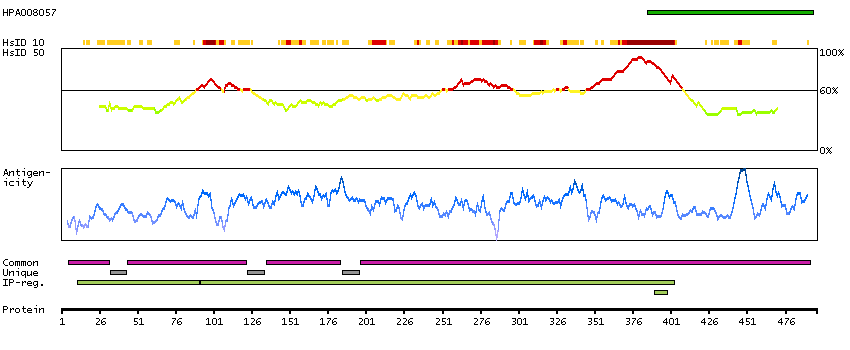
HPA008057 , CAB002059
SHOW MORE

RNA AND PROTEIN EXPRESSION SUMMARY

RNA expression (TPM) Protein expression (score)
Brain
Cerebral cortex
Hippocampus
N/A
Caudate
N/A
Cerebellum
N/A
Endocrine tissues
Thyroid gland
Parathyroid gland
Adrenal gland
Bone marrow & immune system
Appendix
Bone marrow
Lymph node
Tonsil
Spleen
Muscle tissues
Heart muscle
Skeletal muscle
Smooth muscle
Lung
Nasopharynx
N/A
Bronchus
N/A
Lung
Liver & gallbladder
Liver
Gallbladder
Pancreas
Pancreas
Gastrointestinal tract
Oral mucosa
N/A
Salivary gland
Esophagus
Stomach
Duodenum
Small intestine
Colon
Rectum
Kidney & urinary bladder
Kidney
Urinary bladder
Male tissues
Testis
Epididymis
Prostate
Seminal vesicle
Female tissues
Breast
Vagina
N/A
Cervix, uterine
Endometrium
Fallopian tube
Ovary
Placenta
Adipose & soft tissue
Adipose tissue
Soft tissue
N/A
Skin
Skin
Cerebral cortex

Adrenal gland

Lymph node

Liver

Colon

Kidney

Testis

PROTEIN EXPRESSION OVERVIEW

Organ
Expression
Alphabetical

RNA EXPRESSION OVERVIEW

HPA dataset
Organ
Expression
Alphabetical
RNA tissue category: Tissue enriched (cerebral cortex)
GTEx dataset
Organ
Expression
Alphabetical
RNA tissue category: Group enriched (caudate, cerebellum, cerebral cortex, hippocampus, hypothalamus, pituitary gland)
FANTOM5 dataset
Organ
Expression
Alphabetical
RNA tissue category: Group enriched (brain, caudate, cerebellum, hippocampus, pituitary gland, retina)

GENE INFORMATION

Gene name

INA (HGNC Symbol)

Synonyms

NEF5, NF-66

Description

Internexin neuronal intermediate filament protein, alpha (HGNC Symbol)

Entrez gene summary

Neurofilaments are type IV intermediate filament heteropolymers composed of light, medium, and heavy chains. Neurofilaments comprise the axoskeleton and they functionally maintain the neuronal caliber. They may also play a role in intracellular transport to axons and dendrites. This gene is a member of the intermediate filament family and is involved in the morphogenesis of neurons. [provided by RefSeq, Jun 2009]

Chromosome

10

Cytoband

q24.33

Chromosome location (bp)

103277163 - 103290351

Protein evidence

Evidence at protein level (all genes)

Ensembl

ENSG00000148798 (version 83.38)

Entrez gene

9118

UniProt

Q16352 (UniProt - Evidence at protein level)

neXtProt

NX_Q16352

Antibodypedia

INA antibodies

PROTEIN BROWSER

INA-001
INA-201

PROTEIN INFORMATION

Splice variant

UniProt

Protein class

Gene ontology

Length & mass

Signal peptide
(predicted)

Transmembrane regions
(predicted)

INA-001
ENSP00000358865
ENST00000369849
Q16352 [Direct mapping]
Alpha-internexin
Show all
Predicted intracellular proteins
Protein evidence (Kim et al 2014)
Protein evidence (Ezkurdia et al 2014)
Show all
GO:0005198 [structural molecule activity]
GO:0005200 [structural constituent of cytoskeleton]
GO:0005515 [protein binding]
GO:0005615 [extracellular space]
GO:0005654 [nucleoplasm]
GO:0005882 [intermediate filament]
GO:0005883 [neurofilament]
GO:0021762 [substantia nigra development]
GO:0030154 [cell differentiation]
GO:0031965 [nuclear membrane]
GO:0036464 [cytoplasmic ribonucleoprotein granule]
GO:0043209 [myelin sheath]
GO:0045104 [intermediate filament cytoskeleton organization]
GO:0045111 [intermediate filament cytoskeleton]
GO:0060052 [neurofilament cytoskeleton organization]
Show all
499 aa
55.4 kDa
No 0
INA-201
ENSP00000481793
ENST00000616853
A0A087WYG8 [Direct mapping]
Alpha-internexin
Show all
Predicted intracellular proteins
Protein evidence (Ezkurdia et al 2014)
Show all
GO:0005198 [structural molecule activity]
GO:0005882 [intermediate filament]
GO:0005883 [neurofilament]
GO:0007399 [nervous system development]
Show all
496 aa
55.1 kDa
No 0

Contact

  • BLOG
  • PRESS ROOM
  • contact@proteinatlas.org

The Project

  • INTRODUCTION
  • ORGANIZATION
  • PUBLICATIONS
  • DOWNLOADABLE DATA

The Human Protein Atlas

  • ANTIBODY AVAILABILITY
  • LICENCE & CITATION
  • HELP & FAQ
The Human Protein Atlas project is funded
by the Knut & Alice Wallenberg foundation.